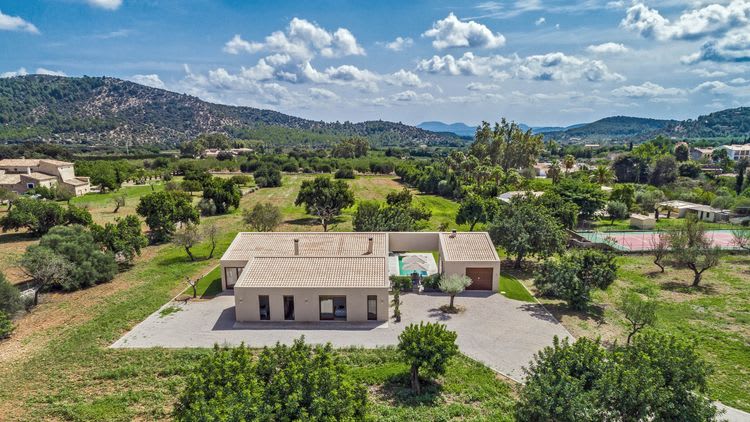
Architect
CLM Arquitectura is a Mallorca-based architecture practice founded by Jaume Colom Mestre, working across residential and hospitality projects on the island. Based in Alaró, a gateway town to the Serra de Tramuntana, the studio's work is grounded in a deep familiarity with Mallorcan landscape and tradition, with a contemporary approach that translates the logic of vernacular architecture rather than imitating it. CLM's portfolio reflects a particular interest in proportion, solidity, shade, and material honesty, working primarily in stone, lime render, and timber to produce buildings that read as authentic additions to the rural Mallorcan landscape. The studio has also developed an ongoing body of work in Mallorcan wineries, bringing together architecture, landscape, and local culture. Baix de S'Era, the studio's first built project, designed almost fifteen years ago in Alaró, remains a defining work and an articulation of the values that continue to guide the practice.
In Conversation
Baix de S'Era was your first built project. What do you remember about designing a house in the Alaró landscape for the first time?
It was a great responsibility, not only because it was my first built project, but because from the very beginning it was something deeply personal. The plot is in the village where I was born, and the commission came from a childhood friend. At that moment, you are not only designing a house, you are also beginning to define what kind of architect you want to become. That project became a kind of starting point for me. It taught me the importance of restraint, of listening carefully to a place, and of understanding that architecture can be quiet without being anonymous. Almost fifteen years later, it remains one of the projects I am most proud of, not only because it was the first, but because it still represents many of the values that continue to guide our work today.
CLM Arquitectura is deeply rooted in Mallorca. How has living and working on the island shaped the way you think about architecture?
Living and working in Mallorca naturally shapes the way we understand architecture. As Mallorcans, there is an almost instinctive respect for the landscape and a very clear awareness that building here always carries a responsibility. The island has a very defined identity in its climate, its materials, its topography and its built heritage, and that inevitably shapes the way we design. For us, architecture begins by understanding those conditions, not by imposing an idea onto them. The philosophy of the studio has always been to combine the logic and restraint of traditional Mallorcan architecture with a more contemporary language, adapted to the way we live today. We are more interested in continuity than imitation: taking what is timeless in local architecture, proportion, solidity, shade and material honesty, and reinterpreting it in a precise and contemporary way.
What does Alaró feel like to someone arriving for the first time, and what do locals know about it that visitors rarely discover?
Alaró is one of the gateway towns to the Serra de Tramuntana, a UNESCO World Heritage Site, and that relationship with the mountains defines much of its character. For someone arriving for the first time, it immediately conveys a sense of calm, authenticity and rootedness. There is something in Alaró that feels solid and permanent, something deeply connected to the place, and that is increasingly rare today. It remains a village with its own rhythm and identity, not a place shaped only by tourism. Alaró is not only picturesque; it is practical, agricultural and deeply tied to the seasons. One of the best ways to understand it is to wander aimlessly through the old part of the village and pay attention to the stone facades, the proportions of its streets, the silence and the way everyday life still unfolds here at a different pace.
Where do you like to eat in the area?
Alaró has a surprisingly varied food scene for a village of its size, and one of the things I like most is that it still feels very local. You can begin the day with a Mallorcan variat, which is probably the most honest way to understand the local food culture: a generous dish made up of small portions of different traditional foods, somewhere between breakfast and lunch. I usually go to Bar Sa Granja. For something more traditional and familiar, Ca'n Punta, on the village square, is always a very good option and has that timeless quality I value. Later in the day, I like the more informal rhythm of going out for tapas with a glass of local wine. In that sense, Artiga is a very good stop, especially for something more relaxed, and Sa Tafona is another place I often recommend.
Is there a walk, a drive or a view in this part of Mallorca that you find yourself returning to again and again? Somewhere that still manages to surprise you?
There are two places I return to often, and both explain very different things about this part of the island. One is the climb to Castell d'Alaró, a 10th-century fortress set on one of the two twin mountains that surround the village. The view from above is extraordinary, not only because of its scale, but because it offers a very clear understanding of the geography of the island. The other is the road that runs from Alaró to the picturesque hamlet of Orient. It is a short journey, but one I never tire of revisiting.
There is a tension in the Balearics between the Mallorca people come looking for and the Mallorca that actually exists. How do you approach that in your work, designing houses that belong to a place rather than impose on it?
That tension is very real, and I believe it is one of the central questions of building in Mallorca today. There is the island people imagine, rural, quiet, timeless, and then there is the real island, which is more complex, more fragile and under constant pressure. As architects, our responsibility is to work with that reality rather than romanticise it. For us, designing in Mallorca should never mean importing a generic idea of Mediterranean life or reproducing a stereotypical image of the island. It should begin by understanding what already exists: the climate, the scale of the land, the agricultural logic, the material culture and the intelligence of vernacular construction. Respecting that does not mean copying the past, but learning from it. Our aim is not to replicate traditional houses, but to translate their logic into contemporary architecture: buildings that are quieter, more precise and more rooted in their surroundings. A house should not try to dominate the landscape. It should reinforce it.
What is the one small detail in a house that immediately tells you whether the design is working?
For me, it is always the sequence of arrival: the way you enter a house and how it begins to reveal itself. It may seem like a small detail, but it usually tells you almost everything about whether a project is working or not. A well-designed house should not explain itself all at once; it should unfold naturally and in an ordered way. That first transition between exterior and interior tells you whether the house understands rhythm, proportion, privacy and light. Beyond that, I believe the success of any project begins with a very careful reading of the site: orientation, views, access, exposure, privacy. If those decisions are resolved properly, the house flows naturally, moving from the more public spaces to the more private ones, giving each the conditions it needs. When that happens, the house feels coherent without needing to announce it.
What are you working on now? Is there anything upcoming that you can share with us?
At the moment, we are working on several single-family residential projects in Mallorca, all quite different in scale and context, but connected by the same underlying interest in place, material and proportion. We are also dedicating more and more time to the transformation of existing buildings, something that interests me especially. There is a particular value in working with what already exists: understanding how to preserve, adapt and reinterpret rather than always starting from zero. That balance between continuity and intervention is something that interests us more and more and that, I believe, will play an increasingly important role in our work. At the same time, since the early years of the studio we have been closely connected to the world of wine in Mallorca. We have developed several projects related to wineries and wine production, and it is a field we continue to enjoy working in very much, because it brings together landscape, architecture and local culture in a very direct way.